First Sunday of Advent 2026: Date, Calendar Rules, and Meaning
Find out when the First Sunday of Advent 2026 takes place, how churches calculate the date, its liturgical role, and traditions like lighting the wreath.
The First Sunday of Advent 2026 falls on Sunday, November 29, 2026. This Sunday opens the Christian season of preparation for Christmas. In Germany, it is not an official public holiday, though occurring on a Sunday means most people have the day off from work anyway.
The timing follows a fixed liturgical rule: it is always the fourth Sunday before Christmas Day on December 25. Because of this calculation, the date shifts between November 27 and December 3. In the Western church calendar, the placement traditionally revolves around the feast day of Saint Andrew on November 30, falling on whichever Sunday is closest to that commemoration.
Finding the date never relies on a fixed calendar day of the month, but on where Christmas lands in the week.
When Is the First Sunday of Advent 2026?
If you want to know when is the first Sunday of Advent 2026, the calendar places it on Sunday, November 29, 2026.
Arriving at the date takes a straightforward count. From December 25, count backward through four Sundays. The Fourth Sunday of Advent is always the Sunday directly preceding Christmas Day. The First Sunday of Advent 2026 marks the first step in this four-part count toward the celebration of the Nativity.
Because weekdays rotate, the date never arrives earlier than November 27 or later than December 3. Whenever December 25 lands on a Monday, the Fourth Sunday of Advent reaches its latest possible date on December 24, sharing the day with Christmas Eve. In that setup, the opening Sunday moves to December 3.
Two other quick rules produce the same result: add three days to the final Thursday of November, or take the Sunday before the first Thursday in December. Western churches follow this method across both Gregorian and Julian calendars. Other rites use distinct timelines. The Ambrosian and Mozarabic rites launch Advent two weeks earlier on the Sunday after Saint Martin's Day on November 11, creating a six-week Advent instead.
The wandering date continues over the following years. In 2027, the season opens on November 28; in 2028, on December 3; in 2029, on December 2; and in 2030, on December 1. By 2031, the opening Sunday lands directly on Saint Andrew's Day, November 30.
Holiday Status in Germany: Is It a Day Off?
Checking German holiday regulations shows that the First Sunday of Advent 2026 is not a statutory public holiday. Neither federal law nor state legislatures classify it as a special legal holiday.
This non-holiday status applies across all 16 federal states. Most workers still enjoy time off on the First Sunday of Advent 2026 because regular office and retail shifts pause on Sundays.
In the German annual calendar, this Sunday marks calendar week 48. It sits within a sequence of late-autumn commemorations: the national day of mourning (Volkstrauertag) on November 15, the Day of Repentance and Prayer (Buß- und Bettag) on November 18, and the Sunday of the Dead (Totensonntag) on November 22, 2026. Right after the season begins, the calendar turns to meteorological winter on December 1, Saint Barbara's Day on December 4, and the Second Sunday of Advent on December 6, 2026.
First Sunday of Advent 2026: Meaning and the Liturgical Year
What theological role does the day carry? The word Advent comes from the Latin adventus, meaning arrival or coming. Christian tradition gives the season a dual character: it prepares believers for Christmas to remember the first coming of the Son of God, while directing attention toward Christ's second coming at the end of time. In Austria, people commonly call it Adventsonntag.
Roman Catholic liturgy begins the new church year on the eve of the day. Celebrating first Vespers on Saturday evening formally closes the old liturgical cycle and welcomes the new one.
The First Sunday of Advent 2026 does not abandon earlier scriptural themes. Instead, it carries forward the sober end-times imagery found in the closing weeks of the outgoing church year. Since the liturgical reform of 1970, the preceding Sunday has observed the Solemnity of Christ the King (moved from late October to the end of the year), highlighting Christ as returning sovereign. The General Norms for the Liturgical Year describe Advent as a time of devout and expectant delight.
Churches have often timed major liturgical updates to coincide with this Sunday. On November 30, 1969, the revised order of Mass from the Second Vatican Council took effect. On December 1, 2013, German-speaking dioceses introduced the updated Gotteslob prayer and hymn book. On December 2, 2018, the revised Catholic lectionary using the standard German translation and the new Protestant order of readings and hymns both took effect.
Worship and Liturgy: Hymns, Readings, and Colors
Church services introduce the new season through distinct scripture readings, liturgical colors, and hymns. Lutheran congregations across Germany and Northern Europe have preserved the historic Gospel reading from Matthew 21. Recounting Jesus entering Jerusalem lends the Sunday an unmistakably celebratory character.
Protestant hymns associated with this opening Sunday include "Nun komm, der Heiden Heiland" and "Wie soll ich dich empfangen." Lutheran services mark the day uniquely by singing the Gloria in excelsis.
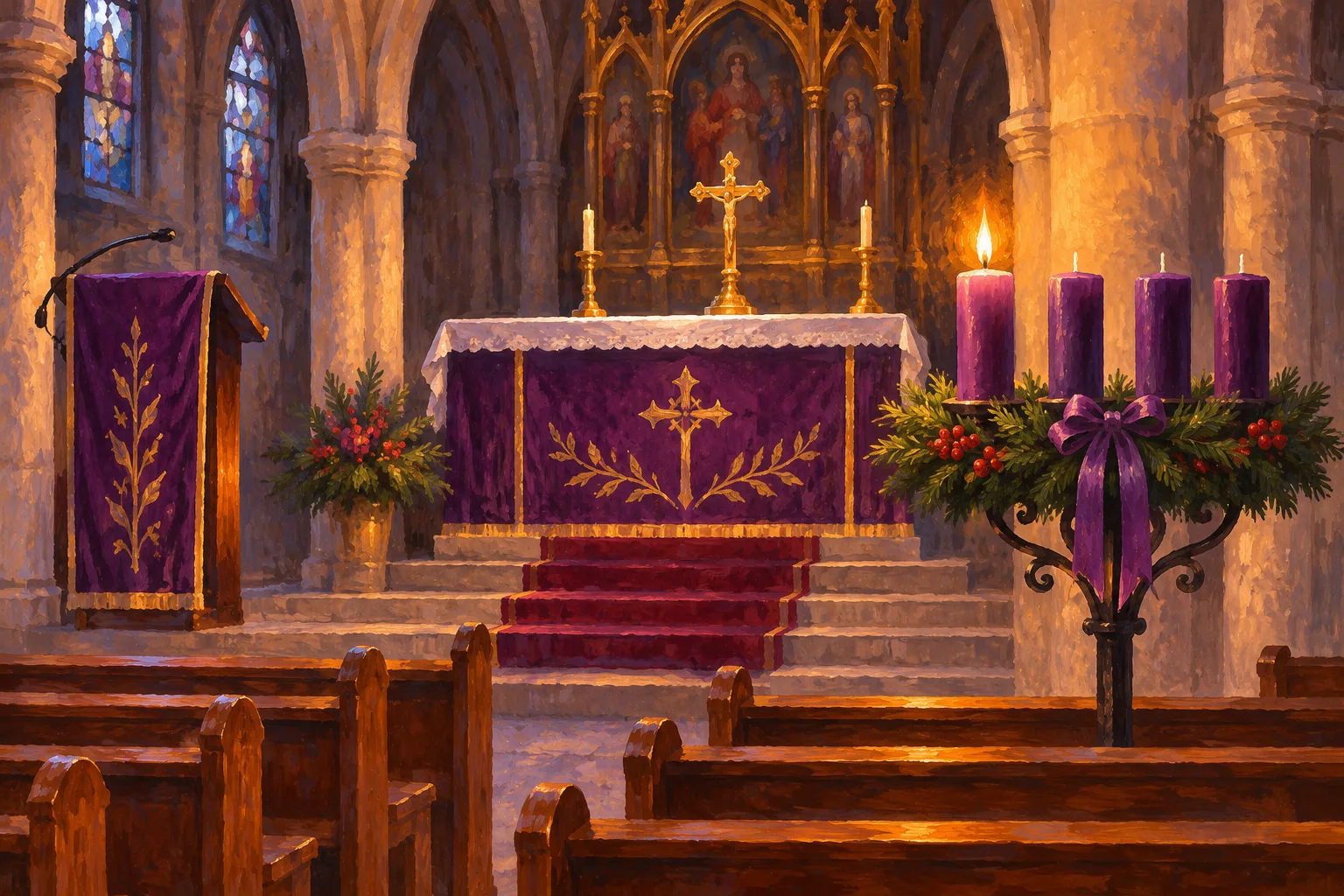
Roman Catholic liturgies switch to violet vestments and paraments. Catholic Masses omit the singing of the Gloria throughout Advent.
The Sunday takes the traditional title Ad te levavi from its opening introit drawn from Psalm 25: "Unto you, O Lord, I lift up my soul." The Roman Missal of 1570 removed Christ's entry into Jerusalem from the Roman lectionary, yet several German dioceses retained it long after; Annette von Droste-Hülshoff composed a poem on it for her cycle Geistliches Jahr. In his 1522 Advent postil, Martin Luther emphasized the humble entry on a burden-bearing donkey rather than a battle charger.
Lutheran, Anglican, and Methodist ministers wear violet or blue paraments, and the first candle lit in church often matches that color scheme. The Church of Sweden uses white paraments during the day as a sign of joy, switches to blue or violet after 6:00 p.m., and reads Zechariah 9 alongside Matthew 21. The Evangelical Lutheran Church of Finland also worships in white while singing Vogler's "Hosianna," before changing to penitential violet or blue on Monday.
The Advent Wreath: Johann Hinrich Wichern's Legacy
When the First Sunday of Advent 2026 arrives, lighting the first candle on the Advent wreath stands out as a core custom. This tradition traces back to Hamburg theologian Johann Hinrich Wichern, who built a candle-bearing wreath for orphans in 1839.
Households and parishes begin by lighting one candle on the first Sunday. Each following week, another flame joins the display. By the fourth Sunday, all four candles burn together, showing Christmas drawing near.
During Christingle services, children receive their own decorated oranges. Other congregations set up a Chrismon tree on opening Sunday or distribute daily devotional booklets.
Advent Customs: Calendars and Christmas Markets
Alongside the wreath, daily habits guide families toward December 24. Opening numbered doors on an Advent calendar remains a staple tradition for counting down the days.
Local customs also involve baking seasonal cookies and walking through winter Christmas markets—browsing booths under warm lights with hot drinks and roasted almonds in the air.

Some congregations hold a service for the hanging of the greens. At home, gatherings over coffee, spiced cookies, and candlelight help mark the season.
ClockZone tools
- Countdown timer
- World clock
- Public holidays in Germany
- Time zone converter
- 2026 public holidays in Germany
References
Images in this article are AI-generated.