Repentance Day Germany 2026: Date, Rules, and Who Gets the Day Off
Also available in: Deutsch·Français·Português (Brasil)
When is Repentance Day Germany 2026? Key facts on the November 18 date, Saxony's paid day off, school closures in Bavaria, and holiday rules.
Repentance Day Germany 2026 falls on Wednesday, November 18, 2026. Known locally as Buß- und Bettag, this Protestant church observance follows a fixed formula on the German ecclesiastical calendar: it always takes place on the Wednesday before Eternity Sunday (Ewigkeitssonntag), the final Sunday of the Protestant liturgical year. That schedule places the day exactly eleven days before the first Sunday of Advent, or mathematically on the Wednesday before November 23. Because of this formula, the calendar date shifts within a tight autumn window. The earliest possible date is November 16, and the latest is November 22.
When is Repentance Day Germany 2026 on the Calendar?
In 2026, the German Protestant church marks the day on Wednesday, November 18. While the calendar number changes annually, the day of the week never moves. Even as a moveable feast, the date always lands on a Wednesday.
Looking beyond Repentance Day Germany 2026, the same rule calculates dates for upcoming autumns. The observance lands on November 17, 2027, and on November 22, 2028. Wednesday remains the anchor in late autumn.
Because the holiday sits eleven days ahead of the first Advent Sunday, it signals the closing stretch of the Protestant church year. Right after it passes, the Advent season begins. Looking further ahead, the day falls on November 21, 2029, November 20, 2030, and November 19, 2031. The sequence continues on November 17, 2032, November 16, 2033, November 22, 2034, and November 21, 2035. The observance is part of a quiet November stretch across Germany: Volkstrauertag (Remembrance Day) occurs three days earlier on November 15, while Totensonntag falls on the following Sunday, November 22, 2026.
Public Holiday Rules: Why Only Saxony Gets the Day Off
Saxony remains the single German state where Repentance Day Germany 2026 continues as a statutory public holiday with paid time off work. Lawmakers dropped the day as a nationwide public holiday in 1994, taking effect in 1995, to offset employer contributions for the newly created statutory long-term care insurance (Pflegeversicherung). The political agreement required workers elsewhere in Germany to give up a paid holiday to balance labor expenses. Saxony rejected that trade-off and kept the paid holiday for its residents.
To preserve the day off, employees in Saxony pay an extra 0.5 percent of their gross salary toward statutory care insurance compared to workers in other states. Employers in Saxony pay correspondingly less. Outside Saxony, legal protections remain: across most federal states, employees can request unpaid leave for religious observances without using an annual vacation day.
That extra payroll deduction for employees in Saxony adds up to more than the wage cost of a single working day over the year. Germany's Federal Constitutional Court reviewed the payroll difference and ruled the extra deduction lawful within the funding framework of the care insurance program. Baden-Württemberg briefly considered eliminating Whit Monday instead in late 1994, but aligned with the interstate consensus in early 1995. Later efforts to restore the holiday included a push by Bavarian Minister-President Edmund Stoiber and a public referendum in Schleswig-Holstein, though neither succeeded.
Critics of the 1995 reform point out that eliminating the holiday failed to prevent deficits in the care fund, which saw additional contribution rate hikes in later years. During a 2019 sermon at the Berlin Cathedral, former Bundestag President Wolfgang Schäuble spoke of repentance and self-examination as a healthy safeguard against social overreach, observing that the moral value of such an occasion cannot be measured on an economic balance sheet.
Schools, Daycare, and Dance Bans: Special Rules Across the States
Most German workers do not get paid time off on Repentance Day Germany 2026, yet state laws enforce regional restrictions. Bavaria stands out: all Bavarian school students have the day off, while teachers must report to work.
Schools in Bavaria often use this pupil-free day for teacher conferences and training. Protestant teachers who wish to attend church services may request release from duty.
Because most Bavarian preschools and daycare centers close alongside schools on Repentance Day Germany 2026, many working parents have to schedule a vacation day to watch their children. Public transit in Bavaria switches to school-vacation timetables. Several states also protect the quiet character of the day under their holiday statutes. Public dancing is prohibited on this date in Saxony, Bavaria, Baden-Württemberg, and Saxony-Anhalt.
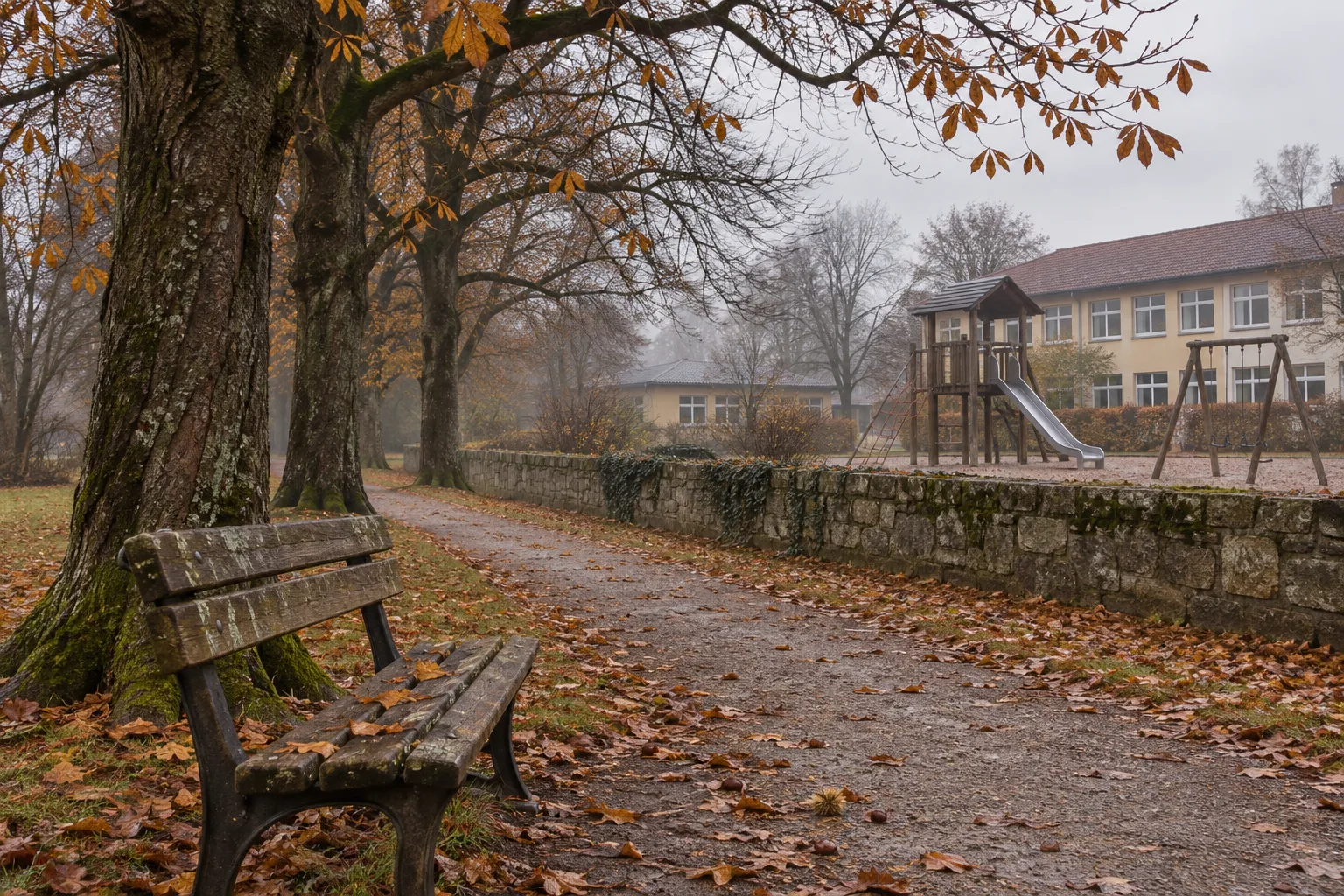
Legal quiet-day restrictions extend beyond dance floors. Depending on local gaming laws, certain states also order public gambling halls and slot-machine venues to shut down. In Bavaria, the student holiday creates annual childcare headaches for households whose workplaces operate normally. Travelers and commuters in Bavaria should check local bus and train connections, as services run less frequently on holiday schedules.
Religious Meaning and the 2026 Motto
Inner renewal, self-examination, and prayer form the core of the religious observance. The official Protestant church campaign for Repentance Day Germany 2026 runs under the German motto "Bitte wenden! Mit dir beginnt Neues"—roughly translated as "Please turn around! Something new begins with you." The theme draws on the Protestant tradition of re-evaluating habits and making room for personal and civic change.
Congregations gather to confess sins, refocus on faith, and examine personal conscience. A 2025 survey showed that 60 percent of people in Germany attach no religious meaning to the date, while another 17 percent reported that it plays only a minor role in their lives.
The theological practice of collective fasting and prayer traces back to biblical passages, including the Book of Jonah. When Jonah warned Nineveh of divine judgment, the city's inhabitants and their king called a fast. The ruler set aside his royal robes, sat in ashes, and decreed that neither people nor livestock should eat or drink in an effort to seek mercy.
Protestant theology assigns three tasks to Repentance Day Germany 2026. First, congregations offer intercessory prayers for communal shortcomings. Second, the church acts as a watchman, pointing out social injustices and ethical missteps. Third, the occasion invites each person to reconsider life choices and step onto a fresh spiritual path.
From Medieval Crises to National Unity: History of the Observance
The practice of public repentance dates well before modern Germany. Charlemagne and medieval rulers proclaimed emergency penance days during famines, epidemics, and wars, directing populations to fast and pray together.
The Protestant Reformation reshaped the practice into recurring church observances. The first Protestant prayer day took place by imperial decree in Strasbourg in 1532 in response to the Ottoman military threat. By 1878, historical records counted 47 separate repentance days across 24 calendar dates within 28 German territories.
A single national date arrived in the twentieth century. The Reich Holiday Act of February 27, 1934, established the day as a statutory public holiday across all German territory. Protestant regional conferences had recommended the Wednesday date back in the nineteenth century, establishing the calculation that still fixes Repentance Day Germany 2026 today.
Ancient precedents include Roman feriae piaculares, held to avert public disasters. Medieval church calendars also featured Ember days (Quatembertage). Pope Gregory VII formalized those periods at the Roman Synod of 1078, scheduling them on the Wednesday, Friday, and Saturday of the first week of Lent, the week following Pentecost, the week after Holy Cross Day on September 14, and the week after St. Lucy's Day on December 13. Strict rules required abstaining from meat and eating only one full meal. Martin Luther criticized the Ember schedule; during the Thirty Years' War, regional rulers declared repentance days as often as once a week.
The Eisenach Conference of Protestant church leaders proposed the Wednesday before the church year's final Sunday in 1852 and again in 1878. Prussia adopted the standard through legislation on March 12, 1893, after its General Synod approved the change the prior year. During World War II, the Nazi regime abolished the weekday holiday in 1939 and shifted it to the following Sunday to increase wartime labor output. West German states brought back the Wednesday observance after the war. Bavaria restored it in 1952 for majority-Protestant areas, expanding it statewide in 1981. East Germany dropped the holiday when it introduced the five-day workweek. German reunification in 1990 restored the holiday across all eastern states, until the 1995 federal reform restricted the paid day off to Saxony.
ClockZone tools
- Countdown timer
- World clock
- Public holidays in Germany
- Time zone converter
- 2026 public holidays in Germany
References
Images in this article are AI-generated.